|
|
 |
2008 Market Crash
The 2008 financial crisis marked a structural change in the world economy. The
crash itself was caused by many years of "markets don't need no stinking
government oversight" but that only set the economy up for a crash. The
structural changes have been growing for decades. The crash did not cause them...
it only revealed them.
The crash was so severe because Americans were told "If you spend like you are rich then you
are rich". What they were not told was that Only the
rich can afford to spend like they are rich. If an
average Joe spends like he's rich he'll spend himself poor (and
make the rich richer in the process). So the middle class spent themselves
into poverty and the rich used all that the extra liquidity to
play an elaborate casino called the derivatives exchange.
A crater formed in the banking system because all the
bets in the liquidity casino were insured by hedging bets (like credit
default swaps). When those providing the insurance did not have the
cash to cover the failed bets they headed to bankruptcy. Those who
bought the insurance could not cover the failed bets (they didn't need to
because they had insurance) also headed to bankruptcy. With the whole system
unraveling the US government had to step in and cover both the insurance
policies and the bad bets. They did this by printing enough money to bail
out all the (important) institutions that were in trouble.
The crater in the middle class was caused by a peculiarity in the US tax system
where mortgage payments on the family home are tax deductable. This seemed
like a sensible policy because mortgage payments for new home owners can be
a heavy burden. With tax deductibility more families can get their first homes and the
leads to stable communities because home owners are better behaved.
In practice the tax treatment was abused because it was not limited to new
home owners...everyone got the deduction. The result was that people mortgaged
their homes to the "market value" and used the low (tax supported) interest rate
to buy renovations, SUVs, appliances and vacations. When the financial
market collapsed the housing market collapsed and many found their mortgages
vastly exceeded the new market value...so they abandoned their homes (not always
successfully: see "zombie mortgages"). The collapse of communities resulted in further
collapse of house prices and the crater deepened.
The US government did not bail out home owners. A bank failure can lead to
a cascade in the financial system that can cause the whole system to fail.
Banks cannot be allowed to fail. A home owner that losses his home just lives
in the family car. There is no risk to the economy. So bankers who make bad decisions
are insured by the government and home owners who make bad decisions are not.
If the 2008 crash had been a "normal" crash the US would returned to 4% plus
growth by 2012. The crater in the middle class would have filled in and
by 2016 everyone would be back to mortgaging their houses to buy SUVs. The
structural change in the economy means the crater in the middle class may
never fill in.
Where have all the middle class jobs gone?
The jobs have definitely gone. The "participation rate" (number of people
with jobs) in the US economy peaked in 1999 and has been declining ever since:
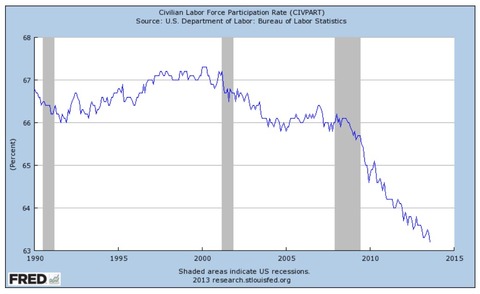
The "unemployment rate" and "job creation" statistics hide this problem. The
worst part is not only are there fewer jobs but there are fewer good jobs. The
median income is dropping. That full time industrial job that bought the house and
raised a family has been replaced by a part time job at minimum wage. Those
who fall out of the middle class end up as the working poor. They work as many
hours (two or three jobs) and they work as hard but at half the income.
So where did the jobs go? Outsourced to some foreign country? No. The work is still
being done here. They were lost to "productivity". A dozen guys with shovels and
a supervisor have been replaced by one guy one in a backhoe and girl directing traffic
at minimum wage. On the assembly line a dozen guys with bolt guns have been replaced by a robot spot
welder. A dozen junior lawyers have been replaced by a computer program that finds
old court cases that are precedents for the current case.
Productivity is amount of work that can been done in a hour of human labor. Increases
in productivity have always been advertized as a good thing. If a human can do twice
as much in an hour that hour is worth twice as much so the wage doubles. It is a
good thing as long as the amount of "work" grows faster than the saving in labor hours.
When productivity grows faster than the amount of "things to do" the total number of labor
hours decline. Surplus labor hours (people) become less valuable and in a balanced market the
wages decline.
Are the jobs coming back? Not those jobs. Are there new jobs being created to take up the
slack? Not fast enough. Is this the end of the middle class? Probably not. Something will
come up (it always does) but from what I've read no one knows when the new jobs will appear
or what tasks only a human can do.
If you want to read more:
"The Culture of the New Capitalism" by Richard Sennett
...good historical back story...no solutions
"The Second Machine Age" by Erik Brynjolfsson and Andrew McAfee
...excellent review of the current situation...weak on solutions
"The Lights in the Tunnel" by Martin Ford
...another good review of the current situation...more weak solutions
"The Zero Marginal Cost Society" by Jeremy Rifkin
...mostly bullsh*t solutions that do not hold up to the simplest analysis
What does this mean for the investor?
If you have money to invest you're still in the middle class. If
events kill your middle class job you may never get back. You
should serious try to build an investment income so you can survive
without a job (financial escape velocity...perhaps $50K/year). Most income from
investments will not be affected by a declining participation rate. A few companies
will suffer from the structural changes but you can avoid them.
Developing economies are less affected by the "productivity trap" because
they have a lot of stuff to do before they catch up. This means the
BRIC countries (Brazil, Russia, India, China) will continue to have high
growth so they will be better places to invest.
Russia has decided that political adventures are more interesting
than economic growth so I'd take them off the list. Of the BIC: China is
maturing fast. Foxconn is buying robots to replace people on their assembly
lines. A machine that works 24x7 in the dark and never complains is cheaper
than a low wage Chinese worker with a rapidly rising consumer appetite. Still an 8% growth
in the Chinese economy in 2014 on a $10 trillion GDP is like a 16% growth on their
$5 trillion GDP in 2009. India is growing slower on a smaller base ($2.0 trillion in 2014)
and Brazil has stalled at a similar base ($2.2 trillion in 2014).
Growth in the US and EU economies are likely to be slow for a long
time (decades? ...see Japan) but that doesn't mean that companies in those economies won't be
growing. A jobless recovery does not mean a stockless recovery. It does mean
that consumer stocks will not be growing because consumer income will be flat (house
prices should be considered a "consumer stock"). Companies with improving productivity will
be great investments (but terrible employers).
What about the all that money they're printing (quantitative easing)? Are we heading
for a hyperinflation collapse where we'll have to take wheelbarrows of cash to
the grocery store to buy a few turnips? Inflation means "wage inflation"...an
increasing cost of labor. If automation is putting and increasing number of employees
on the street there will never be "inflation" no matter how much money is printed.
All that money has to go somewhere and eventully it ends up in the stock market so
stock prices will rise.
The bottom line is that investing in a stock with a 8% growth (stock + dividends) will
give you all of that 8% because inflation will be 0% for decades. At 8% your
money doubles in 9 years...at 10% it doubles in 7. The S&P 500
grew 13.5% in 2012 and 29.6% in 2013.
Buying Stocks on US Exchanges
The US stock markets are the largest and most liquid in the world.
Despite the recent problems with financial products like swaps and
derivatives companies listed on the US exchanges are under strict
regulation and generally their financial reports can be trusted.
If you want to invest in "emerging economy" companies it is safer if you limit
your candidates to those listed on US exchanges. Their stock prices will
include not only their growth in business value but also the growth
in the value of their "head office currency". For example
a Chinese company listed on the NYSE will be subject to US financial
reporting rules but its gain will include the growth of the Yaun against the USD.
The other case is a US headquartered company with most of its business
done in non-US markets. General Electric is a good example because
over 50% of its revenues come from non-US sales and operations (probably
the new General Motors as well). While developing economies are likely to
have appreciating currencies you should continuously monitor the currency risk
even for US headquartered companies.
Choosing a Stock on a US Exchange
Sooty has done some of the work to help identify stocks that are worth
investigating. These are not "buy" recommendations. Sooty is a fellow
investor not a financial advisor.
On the "candidates" page you will find three sections; one for each
of stocks listed on the NASDAQ, NYSE and AMEX exchanges. Included
for each exchange (about 3000 stocks in each) is a spreadsheet in CSV format
along with financial performance measures extracted
from the "Key Statistics" section from Yahoo Finance.
The tables on US candidates page only show dividend paying foreign companies listed
on each of the US exchanges.
It is suggested you read the lecture on shipping
companies to understand the kind of investment strategy Sooty
recommends. Shippers are exactly the kind of stock you should look
at because; 1) they adhere to US rules, 2) they are foreign companies
(mostly Greek), 3) they have foreign customers, and 4) they pay dividends.
If you are still interested in buying US traded companies through these tough
economic times proceed to:
Sooty's Table of
Candidate Stocks on US Exchanges |







 Investing 101